The Food Fraud Database, managed by Decernis, a globally recognised compliance management company, has revealed alarming trends in food authenticity. It reports that honey has emerged as the third most frequently counterfeited food item in the world, surpassed only by the often-falsified categories of milk and olive oil. This raises significant concerns about the integrity of food products that consumers rely on for both health and safety.
Counterfeit manufacturers often resort to deceptive practices that dilute the purity of genuine honey. Typically, they blend authentic honey with various plant-derived syrups, including high-fructose corn syrup or beet syrup. In some instances, these manufacturers might chemically manipulate the sugars found in these inexpensive syrups, altering them to closely resemble the unique flavour and composition of genuine honey. This not only misleads consumers but also poses risks to those who may have allergies or intolerances to the components used in these syrups.
Global Honey Fraud — By The Numbers
The actual prevalence of counterfeit honey remains a subject of debate among researchers and industry experts. The Honey Authenticity Project has reported that around 33% of honey products on the market may be fake or adulterated, highlighting the scale of this issue.
In a study conducted in Australia in 2018, researchers found that around 27% of the honey samples assessed were fraudulent or contained other ingredients that compromise authenticity.
In the European Union, a 2021–2022 coordinated investigation led by the European Commission and its Joint Research Centre uncovered troubling findings: around 46% of the honey samples scrutinised were suspected of being non-compliant. The Commission analysed 320 honey samples across 18 EU member states, of which 147 were flagged as suspicious for added external sugars. Notably, all of the sampled honey imported via the United Kingdom failed to meet authenticity criteria — much of it predominantly imported and re-exported, which complicates transparency in sourcing.
In the UK, testing of supermarket honey has also indicated potential adulteration with sugars. In 2022, the UK imported over 38,000 tonnes of honey from China, its largest supplier, where there are ongoing concerns about honey being mixed with sugar syrup. Since country-of-origin labelling is not always mandatory for products blended from multiple sources, many consumers are unaware that a low-cost jar may originate from China.
How does Manuka Fare?
The answer is — it depends on where it's packed
Manuka's authenticity hinges critically on geographic provenance and the unique Manuka markers. The Ministry for Primary Industries (MPI) in New Zealand provides a rigorous definition: genuine mānuka honey must be produced from bees that collect nectar from the mānuka plant, and any mānuka honey for export must be tested in MPI-accredited laboratories against a strict definition of five key attributes.
Outside New Zealand, there's a troubling lack of equivalent standards, creating room for deception. The Unique Mānuka Factor Honey Association (UMFHA) tested 46 mānuka brands sold in the UK and US that originated outside New Zealand. Every single product fell short of New Zealand's standards for authentic mānuka honey: 82% failed the CODEX quality requirement of <40 mg/kg HMF, 60% failed the naturally occurring 4-HPLA test, and 80% contained no detectable Leptospermum scoparium DNA. UMFHA also found that 32% failed the potency claim on their label — which matters, since methylglyoxal (MGO), the compound behind Manuka's antibacterial activity, is what shoppers are paying for.
How to make sure you're buying the real deal
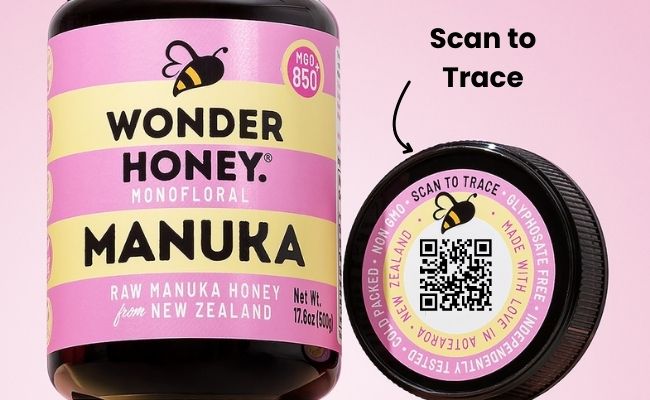
Here at Wonder Honey we believe in an open-book policy — what you see is what you get. We test our honey for 26 different parameters to prove it's genuine Manuka, exceeding both the NZ Government and UMFHA definitions, and we exceed the international Codex standards for honey.
What to look for to know you're getting the real deal:
- Honey packed in NZ
- A high level of MGO
- Passed the NZ Government's 5-marker (including DNA) test
- Meets or exceeds the FAO's Codex standards
- NZ Fernmark licence — certifying the honey was packed in NZ
Sources
- European Commission & Joint Research Centre — EU coordinated action on the authenticity of honey (2021–2022).
- Honey Authenticity Project / Honey Authenticity Network.
- Unique Mānuka Factor Honey Association (UMFHA) — testing of Manuka brands sold in the UK and US.
- New Zealand Ministry for Primary Industries (MPI) — Definition for Mānuka honey.
- Decernis Food Fraud Database.
Read more about our authenticity & testing or trace your honey.
<div class="dynamic-checkout__content" id="dynamic-checkout-cart" data-shopify="dynamic-checkout-cart"> <shopify-accelerated-checkout-cart wallet-configs="[{"supports_subs":true,"supports_def_opts":false,"name":"shop_pay","wallet_params":{"shopId":81423728939,"merchantName":"Wonder Honey","personalized":true}},{"supports_subs":false,"supports_def_opts":false,"name":"paypal","wallet_params":{"shopId":81423728939,"countryCode":"NZ","merchantName":"Wonder Honey","phoneRequired":true,"companyRequired":false,"shippingType":"shipping","shopifyPaymentsEnabled":true,"hasManagedSellingPlanState":null,"requiresBillingAgreement":false,"gatewayType":"CONNECTED","merchantId":"2GGQU7RZZH6TG","sdkUrl":"https://www.paypal.com/sdk/js?components=buttons\u0026commit=false\u0026currency=EUR\u0026locale=en_US\u0026client-id=AexZEtAxk09Ncgj6FSWFFyGKbxxAZ_LTyJ2DPdJWl1YUlecinmc5AfIaRF2qYjWlusWahlzz6SVkY5Ci\u0026merchant-id=2GGQU7RZZH6TG\u0026intent=capture","serviceableCountryCodes":["AT","AU","BE","BG","CA","CK","CZ","DE","DK","EE","ES","FI","FJ","FR","GB","GI","GR","HK","HU","IE","IN","IS","IT","KR","LT","LU","LV","MC","MT","NL","NZ","PL","PT","RO","SE","SG","SI","SK","US"]}}]" access-token="132b5cac3bedfbcbd7438b6acfedfe5f" buyer-country="AT" buyer-locale="en" buyer-currency="EUR" shop-id="81423728939" cart-id="db6b518c3bda92312212a75ddf0784c1" enabled-flags="["a1d1f9a1","f5afabb3","370070f3","b311f899"]" > <div class="wallet-button-wrapper"> <ul class='wallet-cart-grid wallet-cart-grid--skeleton' role="list" data-shopify-buttoncontainer="true"> <li data-testid='grid-cell' class='wallet-cart-button-container'><div class='wallet-cart-button wallet-cart-button__skeleton' role='button' disabled aria-hidden='true'> </div></li><li data-testid='grid-cell' class='wallet-cart-button-container'><div class='wallet-cart-button wallet-cart-button__skeleton' role='button' disabled aria-hidden='true'> </div></li> </ul> </div> </shopify-accelerated-checkout-cart> </div>